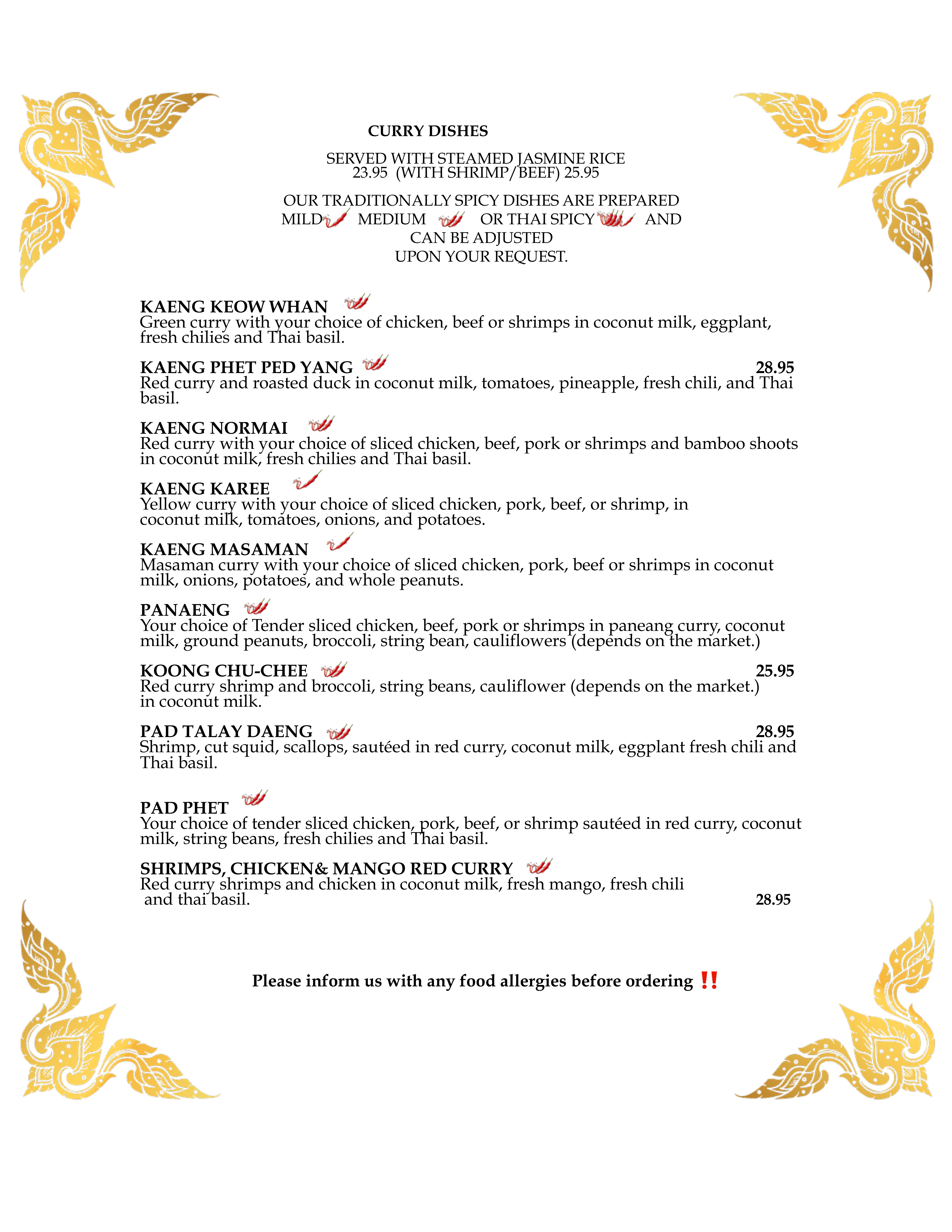
This picture shows a digital menu page for curry dishes from a restaurant, likely formatted for printing or display on a website. At the very top of the page, the bold, uppercase title “CURRY DISHES” is clearly visible, immediately indicating the category of food being listed. Right below the title, there’s a line stating “SERVED WITH STEAMED JASMINE RICE” followed by base prices: “23.95 (WITH SHRIMP/BEEF) 25.95”, which informs customers about the standard side and cost for most dishes.
Another key note appears next: “OUR TRADITIONALLY SPICY DISHES ARE PREPARED MILD / MEDIUM OR THAI SPICY AND CAN BE ADJUSTED UPON YOUR REQUEST” – this explains the spice level options and flexibility for customer preferences, using slashes to separate the spice choices for clarity.
The main section of the picture lists 10 different curry dishes, each with its Thai name (in uppercase letters) followed by a detailed description of ingredients and protein options. For example, “KAENG KEOW WHAN” is described as “Green curry with your choice of chicken, beef or shrimps in coconut milk, eggplant, fresh chilies and Thai basil”, while “KAENG PHET PED YANG” specifies “Red curry and roasted duck in coconut milk, tomatoes, pineapple, fresh chili, and Thai basil” and is marked with a higher price of 28.95. Other dishes like “KAENG NORMAI” (red curry with bamboo shoots), “KAENG KAREE” (yellow curry with potatoes), and “PAD TALAY DAENG” (seafood red curry with shrimp, squid, and scallops) follow the same structure, with some also noting variable ingredients like “(depends on the market)” for vegetables such as broccoli or cauliflower. A few dishes, including “KAENG PHET PED YANG”, “PAD TALAY DAENG”, and “SHRIMPS, CHICKEN & MANGO RED CURRY”, are highlighted with a price of 28.95, which is higher than the base prices mentioned earlier.
Toward the bottom of the picture, there’s an important warning in bold: “Please inform us with any food allergies before ordering !!”, emphasizing safety for customers with dietary restrictions. The overall layout is clean and text-focused, with no images of food or restaurant decor – it’s purely informational, using consistent font styling (uppercase for dish names, regular font for descriptions) to organize content and make it easy to read. There are no people, landscapes, or decorative elements; the entire picture is dedicated to presenting the curry menu details clearly.